It is probably true quite generally that in the history of human thinking the most fruitful developments frequently take place at those points where two different lines of thought meet. These lines may have their roots in quite different parts of human culture, in different times or different cultural environments or different religious traditions: hence if they actually meet, that is, if they are. at least so much related to each other that a real interaction can take place, then one may hope that new an interesting developments may follow.
Werner Heisenberg
Poets are the unacknowledged legislators of the world.
Percy Bysshe Shelley
From time to time, I'm going to indulge in a little utopian thinking. I think we need to do it if for no other reason than as an act of will to stave off the darkness that seems otherwise to be enveloping us. As I've been suggesting in recent posts, the work ahead of us is not to come up with a ten-step strategy or five year plan to a better world or even just to save democracy in the near term. Worthy as those efforts might me, I'll leave that to others.
I am more interested to participate in what I see as a multi-generational project to break free of what constrains us now and so as to enter into a more open, more deeply human, more life-giving cultural space. An important part of such a process is to frame in imagination what such an open space might look like. The goal for us now is to not worry about how to practically get there, but to imagine a place that is worth getting to. We need a north star to guide us. Navigating the storms, counter currents, and stretches of becalm-ment are for later.
So when I recently came across this quote from Heisenberg, it struck me that it was an apt description of my Utopia diagram that I introduced some weeks ago. The two lines of thought he's talking about could be construed as what I'm depicting here as the horizontal and the vertical, i.e., the axis of praxis with the axis of transcendence. The vertical line exists in contemporary culture only on its southern limb, what we call the irrational, Dionysian, or subconscious. I think that is broadly accepted by almost all educated people.
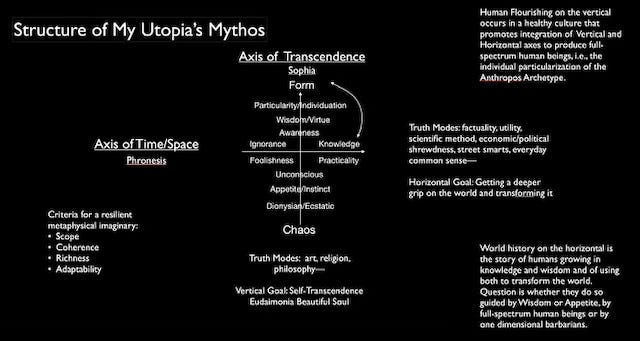
What currently has very little legitimacy, and what needs its legitimacy to be restored, is the northern limb. In the same way that at its best science is an ongoing research project whose results are peer reviewed by eminent members of the scientific community, so must there be a restoration of a similar form of peer-reviewed research on the entire vertical axis, north and south, by eminent members of a sapiential community.
No such sapiential community exists now because the wisdom tradition in the West became too identified with the defense of creeds and dogmas rather than with truth and wisdom. The decisive break came after the Thirty Years War pitched Protestants against Catholics from 1618-1648. It was the most savage and devastating European War until the 20th Century. What motivated these wars had absolutely nothing to do with the spirit and wisdom of the gospels, but with tribal-credal rivalries. Nevertheless, the takeaway any sane, decent person could take away from that disgraceful period was clear: if this is the way Christians treat one another, then credal Christianity could not be taken seriously. The churches self-delegitimated, and never really recovered.1
People are innately religious, so they continued traditional practices on the ground level, so to say, but the Churches lost the intelligentsia, and that created a situation that was unique in the West. The intelligentsia did not, at first, reject the idea of a transcendent Deity, just the Church's moral authority to say anything meaningful about it. Reason, not creeds and dogma, became the ultimate authority. But reason, as essential as it is, inevitably becomes the Emissary that usurps the authority of the wise master because the wise master has lost its institutional foundation. The fragmentation of the church into a hundreds of sects made it easy for everyone to disregard anything Christians had to say, even when they were making good sense. This is what cleared the space for the emergence of an unchecked Transhumanism and the culturally devastating effects of industrial capitalism. And it goes a long way to explain why these developments are uniquely Western in their origin.
So the Thirty Years War and the English Civil War that took place during the same period had nothing whatsoever to do with Christianity except in some primitive tribal sense. But despite the fanaticism of these warmongers, individual decent human beings have always been able to find their way to discover what is best, deepest and wisest. It's just that angry, fearful humans who happen to be Christians in name if not spirit tend to act more like mobs than like saints, and Church leaders tend to act more like turf-and-prerogative-conscious bureaucrats than like sages. That isn't unique to Christians, but it had particularly disastrous consequences for the West in the way it played out.
So two points: First the obvious, that people who call themselves Christians are not immune from everything that is corrupting about being human and are often worse than average in their cruelty. But that doesn't mean that there are no genuine saints and sages. Because of the events of the 1600s, saints and sages just don't matter for us anymore in the way we make our decisions in the political and economic spheres, and they should.
The second point is less obvious because of the way we have come to understand truth. Because educated people are so inured to the methodologies of the social sciences, we tend to think that the real truth about human beings lies in statistically predictable behaviors, and we reject the anomalous as noise. But on the vertical axis it's the statistical anomalies that are most representative and disclosive of vertical truth. It's the statistically few that we must look toward, rather than to the statistically average. It is what the quality of the few tell us about human possibility that matters more than what we accept as the mediocrity of the all-too-human. That's not how your typical social scientist looks at the human condition, and if we're good, educated Liberals we listen to what social science has to tell us, right? They've got the data to back up their "knowledge". No need for wisdom, and too often, no need for even a little common sense.2
We don't have a problem accepting this celebration of the statistically anomalous in athletics or musical performance, but we do in matters of the spirit. We are constrained for good reason by fears of spiritual pride, and there is a healthy democratic impulse at the heart of what's best in Christianity that wants to celebrate the everyday goodness of ordinary folk. I would love to live in a society that celebrated the sanctity of everyday life and the earthy wisdom of ordinary good folk the way our ancestors did. But that's a world long gone, and at best we have now only zombie or counterfeit versions of it in MAGAland. There is very little wisdom in the heartland anymore. It's there in some individuals, but not in the culture. The TCM has destroyed whatever was once wholesome in that. But that doesn't mean that it couldn't some day be restored. That would be an essential feature of my utopia.
The question is how to restore something like that wholesomeness, where there is a good life for ordinary people while at the same time a gradual, lawful expansion of knowledge on both the horizontal and vertical axes that would benefit everyone. And that means that the anomalies, the geniuses, the humans with special gifts on both the horizontal and vertical axes that together in an effort to maintain a balance between them, must play an outsized role in shaping the direction of human evolution.
But this can't be left to just those working on the horizontal axis. Horizontal work if left to itself is driven by amoral, dehumanizing energies that, for instance, animate the Transhumanists. Horizontal work needs to be guided, balanced, and, where necessary, checked by a sapiential community that has earned broad moral authority. This sapiential community would be peopled by the geniuses on the vertical axis–the poets, sages, and saints that any truly healthy society would produce and recognize.
I know that this conjures fears about Inquisitors and Ayatollahs, and for good reason. But our fear of the worst possibilities shouldn't preclude our aspiration to the best. At the very least, a balance must be restored between horizontal and vertical poles because giving the Transhumanists free rein leads to catastrophe. And in the meanwhile we need some utopian thinking to counterbalance the dystopia to which inevitability we've become resigned.
And in my utopian society, a new/old kind of participative knowledge on the vertical axis will be for most humans more interesting and rewarding, because it will be all about developing richer, deeper connections with the natural world and with one another. My utopia will be a place where people have leisure in a way that is unimaginable for most now. It will provide a trellis, a cultural framework of 'goods' that lay out practices, often very challenging practices, that will enable the cultivation of the souls of healthy citizens to grow toward their individual eudaemonic telos.
This, btw, is why I don't have a problem with tech as tech. I'm all for it if it's used to liberate people from soulless labor for something soulful. The problem now is that tech without the northern limb is more likely to produce the Last Man dystopias imagined in WALL-E or Brave New World if not the post-catastrophe, neo-barbarian world of the Mad Max movies.
Those who become most prominent on the vertical axis will be truth seekers, not the inquisitors, political hacks, and bureaucrats as in most historical theocracies. In my utopia, work on the horizontal axis will serve the work on the vertical. In other words, the vertical will be the realm of the wise master in McGilchist's story,2 the dimension where the most important discoveries are made, and the horizontal will be the emissary, the dimension where the the practical implications are worked out and implemented.
It's a start.
BTW, I'm working on an essay entitled "Rescuing Aristotle". It's objective is to unpack the First Day of Hart's imagined colloquy between the gods in his All Things are Full of Gods. This is very rich, and the challenge for me is to write about it in a way that can convey that to readers why such hi-falutin intellectualizing is relevant for their lives as individuals, but more importantly in the long run for our lives together.
Notes
1. I am a credal Christian, but I relate to the creed not as a set of propositions, but as a portal into a deeper mystery that can only entered into with what Paul Ricoeur calls 'second naivete' and what John Keats calls 'negative capability'.
Because the Tao/Logos that can be spoken is not the Tao/Logos. In other words, the map is not the territory. That's the mistake that dogmatists and fundamentalists make–they make idols out of propositions, rather than to be drawn into them and past them into something far more vital than a mere intellectual assent to propositions that seem on the face of it to be absurd.
2. In other words, no need for Sophia or Phronesis. See diagram.
3. This is what Iain McGilchrist in recounting Nietzsche's tale of the Master and the Emissary in the Introduction of his book of that title:
There is a story in Nietzsche that goes something like this. There was once a wise spiritual master, who was the ruler of a small but prosperous domain, and who was known for his selfless devotion to his people. As his people flourished and grew in number, the bounds of this small domain spread; and with it the need to trust implicitly the emissaries he sent to ensure the safety of its ever more distant parts. It was not just that it was impossible for him personally to order all that needed to be dealt with: as he wisely saw, he needed to keep his distance from, and remain ignorant of, such concerns. And so he nurtured and trained carefully his emissaries, in order that they could be trusted. Eventually, however, his cleverest and most ambitious vizier, the one he most trusted to do his work, began to see himself as the master, and used his position to advance his own wealth and influence. He saw his master’s temperance and forbearance as weakness, not wisdom, and on his missions on the master’s behalf, adopted his mantle as his own – the emissary became contemptuous of his master. And so it came about that the master was usurped, the people were duped, the domain became a tyranny; and eventually it collapsed in ruins.
The meaning of this story is as old as humanity, and resonates far from the sphere of political history. I believe, in fact, that it helps us understand something taking place inside ourselves, inside our very brains, and played out in the cultural history of the West, particularly over the last 500 years or so. Why I believe so forms the subject of this book. I hold that, like the Master and his emissary in the story, though the cerebral hemispheres should co-operate, they have for some time been in a state of conflict. The subsequent battles between them are recorded in the history of philosophy, and played out in the seismic shifts that characterise the history of Western culture. At present the domain – our civilisation – finds itself in the hands of the vizier, who, however gifted, is effectively an ambitious regional bureaucrat with his own interests at heart. Meanwhile the Master, the one whose wisdom gave the people peace and security, is led away in chains. The Master is betrayed by his emissary. (p. 14)
Leave a Reply