Matthew Crawford's Phronetic Philosophy
The idea of agency I have tried to illustrate in this book is different. It is activity directed toward some end that is affirmed as good by the actor, but this affirmation is not something arbitrary and private. Rather, it flows from an apprehension of real features of the world. This may be something easy to grasp, as when a master plumber shows his apprentice that he has to vent a drain pipe a certain way so that sewage gases don’t seep up through a toilet and make a house stink. Or it may be something requiring discernment, as when a better motorcyclist than I explains, from a rider’s point of view, why it would be good to decrease the damping in the front end of his motorcycle.
In activities that are directed toward some end (a well-vented drain pipe, a balanced chassis), the goodness of the end in question isn’t simply posited. There is a progressive revelation of why one ought to aim at just this, as well as how one can achieve it. As you learn your trade this particular end takes its place in a larger picture that is emerging, a picture of what it means to be a good plumber or a good mechanic. …The progressive character of revelation energizes your efforts to become competent—something about the world is coming into clearer view, and it is exciting. The sense that your judgments are becoming truer is part of the experience of being fully engaged in what you are doing; it is a feeling of joining a world that is independent of yourself, with the help of another who is further along….
Such a sociable individuality contrasts with the self-enclosure that is implicit in the idea of “autonomy,” which means giving a law to oneself. The idea of autonomy denies that we are born into a world that existed prior to us. It posits an essential aloneness; an autonomous being is free in the sense that a being severed from all others is free. To regard oneself this way is to betray the natural debts we owe to the world, and commit the moral error of ingratitude. For in fact we are basically dependent beings: one upon another, and each on a world that is not of our making. To live wakefully is to live in full awareness of this, our human situation. To live well is to reconcile ourselves to it, and try to realize whatever excellence we can. For this some economic conditions are more favorable than others.
When the conception of work is removed from the scene of its execution, we are divided against one another, and each against himself. For thinking is inherently bound up with doing, and it is in rational activity together with others that we find our peculiar satisfaction. A humane economy would be one in which the possibility of achieving such satisfaction is not foreclosed ahead of time for most people. It would require a sense of scale. We in the West have arranged our institutions to prevent the concentration of political power, with such devices as the separation of legislative, executive, and judicial functions. But we have failed utterly to prevent the concentration of economic power, or take account of how such concentration damages the conditions under which full human flourishing becomes possible (it is never guaranteed). The consolation we seek in shopping serves only to narcotize us against a recognition of these facts, even while contributing to the Giant Pool of Money.
Too often, the defenders of free markets forget that what we really want is free men.
From Shop Class as Soulcraft: An Inquiry into the Value of Work, pp 205ff.
One of the themes discussed in Douthat's interview with Kokotajlo that I wrote about last week focused on how AI will increase productivity and economic bounty, but without much human contribution to it. So this raises significant questions about (1) how will that bounty be distributed? and, (2) what will the masses of unemployed do with their leisure? The Calvinist careerist/meritocrat work ethos that provides the meaning structure for the TCM will likely become obsoletized. No longer will people measure their worth by some meritocratic standard; people will have to find meaning elsewhere. That could be a disaster or it could open up a space for people to realize their value as human beings by a different, healthier standard.
I assume that, despite the American conservative obsession with eliminating all government entitlement programs, that some kind of UBI will become necessary. People in the tech world seem to understand this inevitability before conservatives who see the future in the rearview mirror do. But delusion is the coin of the realm these days, and while reality has no constituency in our politics, one way or the other, sooner or later, Reality will assert itself.
Conservatives are right that it's better for people to work than to sit at home all day playing video games or getting high on opioids and fentanyl, but it's also understandable why playing video games and substance abuse are so tempting when there isn't much in the TCM to offer as a wholesome, unalienating alternative—certainly not working in a cubicle or at Walmart. The Oren Cass project of returning manufacturing jobs to the U.S. from China isn't a cure if it just means a way for people to make a buck by pushing buttons to instruct robots to do the manufacturing in the larger dubious project to enrich the company's shareholders.
So reality will assert itself, and it could lead us to react in two ways. The first more likely one, given the logic of life in the TCM, is something along the lines imagined in Huxley's dystopian Brave New World. The second, less likely, but more healthy utopian future was imagined in William Morris's 1888 News from Nowhere. For Morris work, especially manual work–craft and working with the soil (a la Wendell Berry), isn't alienation, and it isn't done by machines. Rather it's understood as a path of freedom and human flourishing–what Crawford is pointing to in the excerpt above.
Morris, a hater of how capitalism made work dehumanizing, was one of the founders of the Arts and Crafts movement in architectural and furniture design in the late 19th century. He imagines a utopia where there are no machines–he is something of a Luddite—but I see his machine-free utopia as taking an extreme position as a way of emphasizing an important truth: work can be liberating if we recover a pre-industrial-revolution understanding about how it need not be so deeply alienating and meaningless.
I can imagine a world where the machines do the work that is most alienating, and leave the work that is meaningful to humans. We dread the machines taking away our jobs, but if we weren't so materialistic in our thinking, we should see it as a potential liberation from meaninglessness and alienation. As I said above, If work in the meritocracy no longer provides meaning, we will need to find life's meaning elsewhere. That doesn't mean that humans stop working, but that they find in work a way to practice forms of soulcraft. Our work becomes valuable not for its market value, but for its soul value.
I know. Hard to imagine how we get from where we are now to such a conception. As a society we would have to find a collective wisdom that we currently do not possess. But things are really going to get shaken up in the next twenty or thirty years, and anything is possible–we ought not to assume that the worst is the only possibility. And while the best is unlikely, we should at least frame some imagination of what that might look like, and that requires, as I’ve been arguing, a richer, deeper understanding about what a human being is, and what its telos is.
This idea of work being meaningful is Crawford's beat. He and Morris are kindred spirits, even if Morris might have some doubts about the desirability of motorcycles: Crawford has a doctorate in philosophy from the University of Chicago, but has spent most of his working life as a motorcycle mechanic.
The excerpt above comes from the closing pages of the book, which is a cri de coeur for Americans to start living in their bodies again, to live in the real world not in virtual ones, to accept constraints as essential for giving our lives definition, shape, form, something that forces us to do difficult things, to overcome the intractable stubborness of the material world whose fundamental purpose is there to resist us to give us something to overcome. He's preaching that's the way for us to to become free men and women in deepest sense of what it measures to be free, not in the phony, consumerist TCM sense of choosing between a Tesla or a Rivian, a white one or a red one.
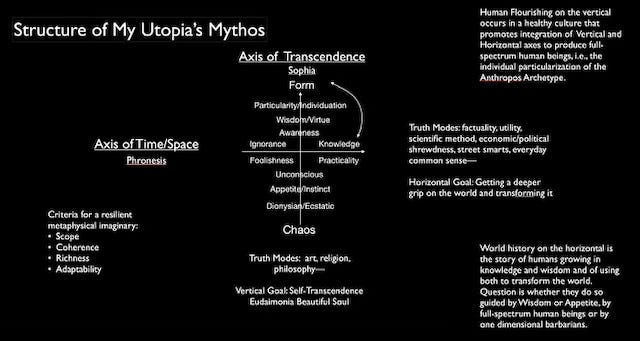
There's much more to say about this as it relates to my Rescuing Aristotle theme. In the diagram of my imagined utopia–see below– I have so far mostly spoken about the need to restore the amputated northern limb on the vertical axis, but Crawford and Morris are all about the horizontal axis, the axis of Phronesis, or Practical Wisdom. I want to spend some time working through what the horizontal entails, and how it relates to and needs to be integrated with the vertical axis, the axis of self-transcendence and Sophianic Wisdom.

Leave a Reply